Guide
Where your prompts actually go, and what self-hosting does not fix
People ask one question about prompt data when they mean three. Separating them shows what running a model on hardware you control genuinely changes, and what it leaves entirely on you.
- Topic
- Data handling
- Reading
- About 8 minutes
- Published
- 3 August 2026
- Applies to
- All plans, Medusa
Contents
The short version
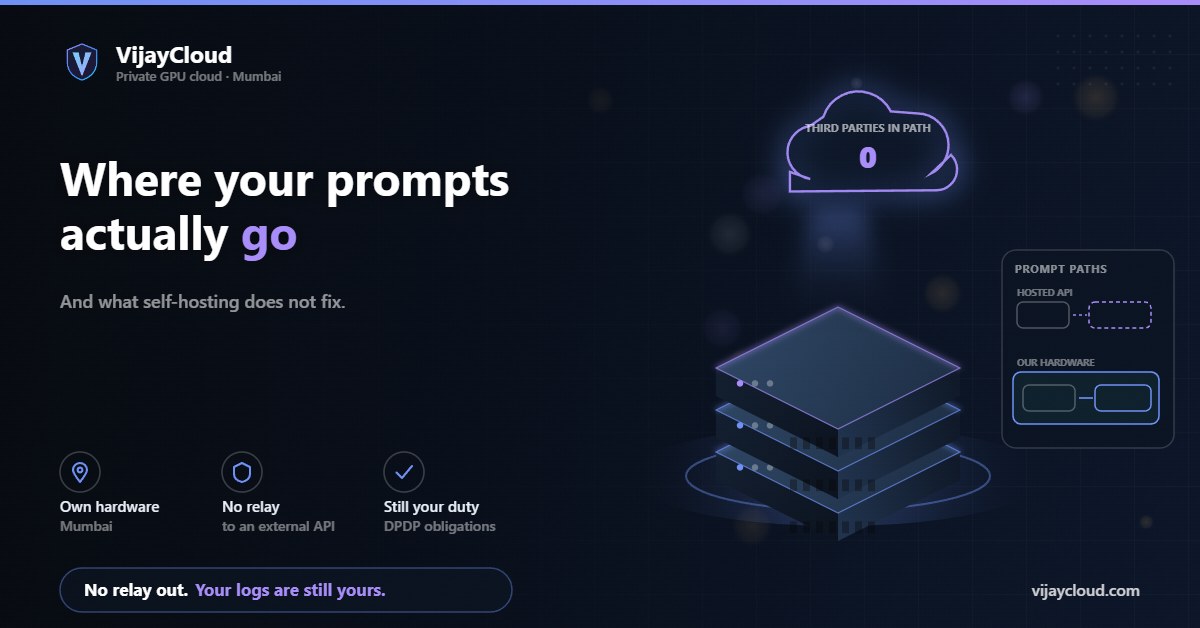
Self-hosting removes a third party from the path your prompts travel. It does not remove your own obligations, and it does not delete your logs. If you log prompts for debugging, you have created a personal data store with your name on it, and under the DPDP Act you are the one answerable for it.
01Three questions asked as one
“Is my data safe with your AI?” is really three separate questions, and they have different answers:
- Is it used to train models? A question about purpose limitation.
- How long is it kept, and who can read it? A question about retention and access control.
- Whose law applies, and in which courts? A question about jurisdiction, decided by where the data physically sits and who the contracting parties are.
A provider can answer the first impeccably and still fail the second and third. Conflating them is how organisations end up reassured by a marketing sentence that addresses none of what their compliance team will actually ask.
02What an API call commits you to
When you send a prompt to a hosted model API, several things happen that are easy not to think about. The text crosses an organisational boundary. It is usually retained for some period, frequently for abuse monitoring even when it is excluded from training. It may be readable by the provider’s staff under defined conditions. And it lands in whatever jurisdiction the provider operates in, which determines who can compel its disclosure.
None of that is necessarily wrong. Large providers generally document it clearly and many organisations accept it after review. The problem is accepting it without the review, because if the prompt contained a customer name, a medical detail or a salary figure, you have made a cross-border transfer of personal data and you are the one who has to justify it.
03What your own hardware changes
Running the model on infrastructure you control collapses several of these questions into one you can answer yourself. The prompt does not leave the boundary. There is no third-party retention window to read about, no separate abuse-monitoring copy, and no second organisation whose staff access policy you have to evaluate. Jurisdiction becomes simply where the machine is.
That is the architecture behind Medusa. It serves several open models — gemma3:12b, gemma4:12b, qwen3.6 and deepseek-r1:14b — from our own hardware in Mumbai. A prompt to Medusa is not relayed to an external model provider, because there is no external model provider in the path.
The same logic applies more strongly to your own Instance, where you hold root and we are not in the inference path at all. Our Privacy Policy §5 states the operational commitment: our personnel do not log into your Instance, inspect its filesystem or read Customer Content in the ordinary course of running the platform, and access it only under defined conditions.
04What it does not change
This is the part usually left out of posts like this one, and the part that matters if you are the person signing off.
You are still the data fiduciary. Self-hosting is an architectural decision, not a compliance exemption. Under India’s DPDP Act your duties around notice, purpose limitation, security safeguards, breach notification and grievance redressal are unchanged by where the GPU sits. Our post on what the DPDP Act actually asks of you works through them.
Your logs are the new exposure. This is the most common own-goal. Teams move inference in-house for privacy reasons, then log full prompts and completions to debug quality, and now hold an indefinitely retained store of user text on a box with no retention policy. The third party is gone; the risk moved, it did not disappear. Decide deliberately what you log, for how long, and who can read it.
Residency is not all-or-nothing. Your Instance and the model run in Mumbai. That does not mean every byte connected to your account stays in India. Account, billing and analytics data touch providers operating elsewhere. Our Privacy Policy §9 says plainly that personal data may be processed in India, the European Union and the United States, and names the safeguards relied on. Any provider telling you a cloud service keeps absolutely everything inside one border is either running their own payment rails and email, or has not checked.
Certifications are separate from practices. Good practices and an audit report are different things. Our §10 says explicitly that we make no claim to hold any certification or audit report we have not actually obtained. If your procurement process requires a specific one, ask before building a plan around us.
05Questions worth asking anyone
Including us. If a provider cannot answer these from documentation rather than a sales call, that is itself the answer:
| Question | What you want to hear |
|---|---|
| Where does inference physically run? | A named country and facility type, not “the cloud”. |
| Is any prompt relayed to a third-party model API? | A yes or no, with the third party named if yes. |
| What is logged, and for how long? | Specific categories and specific periods, in writing. |
| Under what conditions do staff access my environment? | Enumerated conditions, not “as required”. |
| Which entity am I contracting with, and whose courts? | A legal entity name and a jurisdiction. |
| Which certifications do you actually hold? | Only ones they can produce on request. |
| What happens to my data when I leave? | A deletion timeline you can point at later. |
06Where we stand, precisely
Rather than a claim, the documented positions and where to check each one:
| Item | Position | Source |
|---|---|---|
| Inference location | Our own hardware in Mumbai, India | Pricing, Privacy §4 |
| Instance access by our staff | Not in the ordinary course; defined conditions only | Privacy §5 |
| Access and security logs | 90 days | Privacy §6 |
| Usage and billing telemetry | 13 months | Privacy §6 |
| Support correspondence | 24 months | Privacy §6 |
| Account data transfers | May be processed in India, the EU and the US | Privacy §9 |
| Tenancy | No shared tenancy on your allocated GPU | Pricing |
| Grievance Officer | Mukesh Gadkari, response within 30 days | Privacy §8 |
If you need something we have not documented, ask rather than assume: privacy@vijaycloud.com. A gap in our documentation is a gap, and we would rather correct it than have you infer a commitment we have not made.
Related: DPDP and training data · Medusa · Privacy Policy
Leave a Reply